
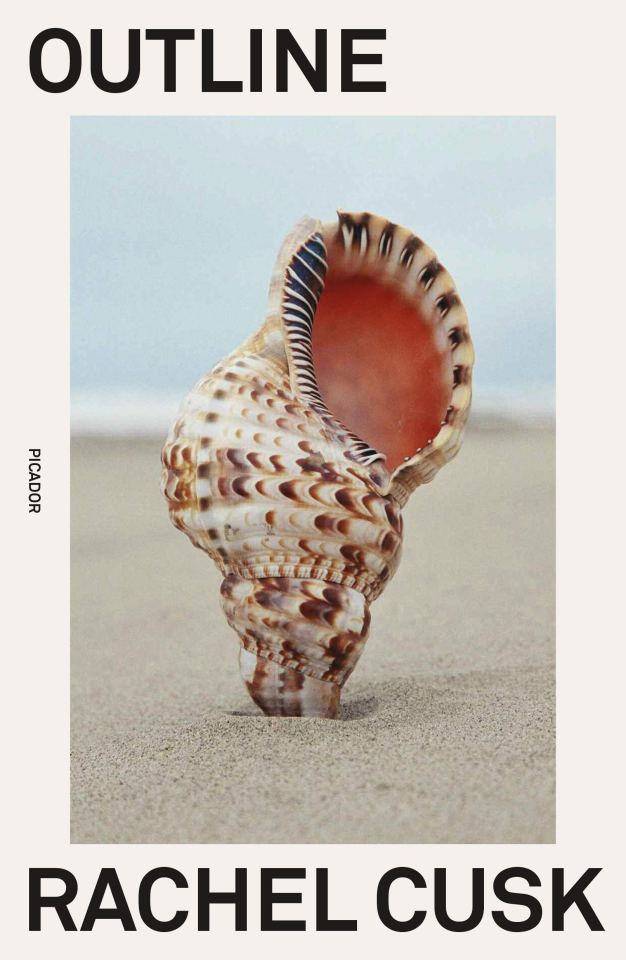
Outline, by Rachel Cusk
Rachel Cusk’s semiautobiographical novel Outline is an enormously small book. Of course, her flamboyant and disastrous literary reputation precedes it. Five novels and three memoirs deep—one of which was destroyed, another which seems to have destroyed her family—the sprawling discourse which surrounds her seems to dwarf the relatively unassuming Outline, itself written in an act of intentional personal erasure. It is a book so swollen with self-effacement and negative space that reading it can feel like watching someone try and stuff the great blank anonymity of the ocean into a single seashell. Even the wide margins of the pages act like a funnel guiding the words to a blunt point.
At the crossroads of memoir and fiction, the book follows Faye, our narrator, (the name mentioned only once in the second to last chapter) as she visits Athens to teach a creative writing course. We only see a few days pass chronologically in the span of the novel, but we encounter a cavalcade of shattered divorcées, betrayed parents, and hollowed-out writers (often a character is all three at once) whom Faye encounters and departs from with an astonishing stoicism. Like Cusk herself, Faye is divorced with two children and seems to be sifting through the wreckage of her person while spinning the wheels of a writer’s life. The book’s characters have a pronounced ability to wax profound with an eerily communal sense of heterosexual fatalism; while the particular details that make up the life of the clumsy Greek heir differ from Ryan the Irish writing teacher’s, from Paniotis’, from Elena’s, etc.—everyone Faye encounters during her trip to Athens seems oddly tuned to the same wavelength which whispers of the mutually assured destruction that is monogamy and parenthood. It would not be hard to read this book as a radical queer screed against the mute horrors of the bourgeois nuclear family; as Paniotis says in chapter V, “Writers need to hide in bourgeois life like ticks need to hide in an animal’s fur: the deeper they’re buried the better”.
Outline is a Good Book in a kind of classic sense: impeccably crafted and varnished with a layer of unassuming placidity so thick that its moments of grandeur and insight arrive as if from nowhere. Early on, for example, while talking with the Greek heir sitting next to her on the flight to Athens, she writes:
For the second time I felt the conscious effort of his enquiry, as though he had trained himself in the recovery of objects that were falling from his grasp. I remembered the way, when each of my sons was a baby, they would deliberately drop things from their high chair in order to watch them fall to the floor, an activity as delightful to them as its consequences were appalling…Eventually they would begin to cry, and usually found that the fallen object came back to them by that route…The memory of suffering had no effect whatever on what they elected to do: on the contrary, it compelled them to repeat it, for the suffering was the magic that caused the object to come back and allowed the delight in dropping it to become possible again.
It’s startling how finely wrought this digression is; it occupies something like an entire page and signals that what’s significant is not their conversation per se but what is not being said (how brutally English). In fact, it is rare to follow a conversation in this book in which the participants respond meaningfully to each other’s words. There is an air of harsh unreality to the way these people speak, as if they’re each not quite people themselves but vessels harboring variations on the same kind of beautiful suffering.
Of course, this speaks to whether or not the book itself is fiction or nonfiction—an ultimately tedious question, to say the least. To the extent that, as a structure, it works well for its author and allows her to perform an act of self-erasure that’s genuinely enthralling, it’s compelling enough. But the thought of hashing out the nitty-gritty of the Limits of Verisimilitude is rather exhausting and ultimately a disservice to the book. If what’s being peddled as innovative here is that it’s “sort of true, sort of not” I have a hard time seeing how it differs from any other book of fiction ever written. What seems to be of significance is not which details are true, which false (or the extent to which this structure is as much a legal strategy to avoid further litigation), but the difficult, tenuous relationship it has to Cusk’s own life which has evolved into an impossible fiction of its own. Nonfiction writers have made an occult art of parsing out the truthiness in writing, yet rarely do they acknowledge how fiction tends to leak into our waking lives.
 Joshua Palmer